

*Formerly known as the pkDO Foundation
Genetic Diagnosis and Embryo Screening in Autosomal Dominant PKD (ADPKD)
This article was prepared in collaboration with Orchid Health, a reproductive genetics laboratory specializing in advanced preimplantation genetic testing for monogenic disorders (PGT-M). The content has been reviewed by PKD-Free Alliance and is presented for educational purposes.
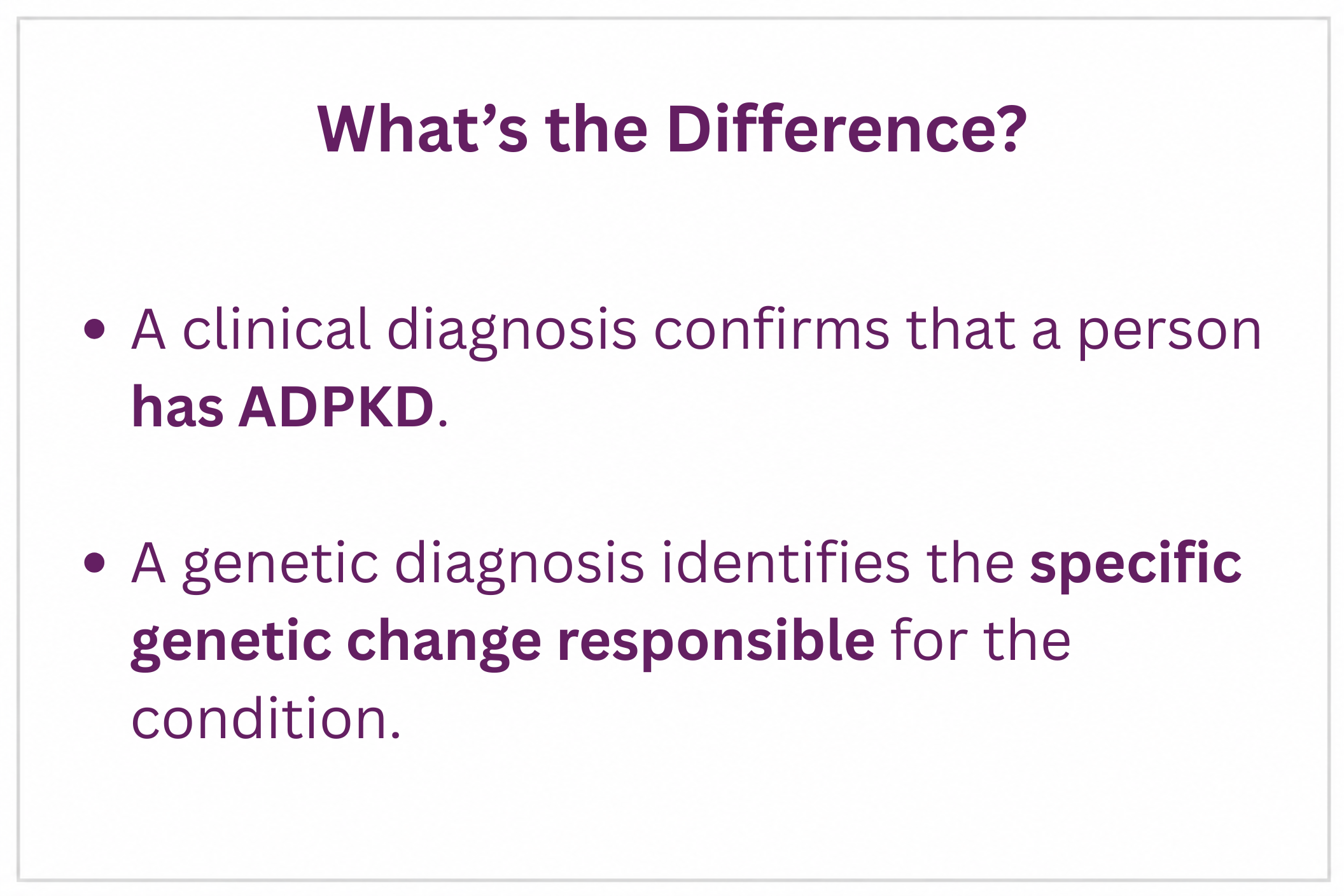
Autosomal dominant polycystic kidney disease (ADPKD) can often be diagnosed clinically, either through kidney imaging that meets established age-based criteria or through a combination of clinical findings and a positive family history of ADPKD. For many individuals, a clinical diagnosis is sufficient to confirm the diagnosis and guide medical care.
However, even when ADPKD is diagnosed clinically, its underlying genetic cause remains important, particularly when considering family planning options.
This article reviews genetic testing for ADPKD, why a confirmed genetic diagnosis is necessary for certain family planning options, and how embryo screening with preimplantation genetic testing for monogenic conditions (PGT-M) works.
The Genetics of ADPKD and Why Genetic Testing Can Be Challenging
Most cases of ADPKD are caused by changes in the PKD1 gene, while a smaller number are caused by changes in PKD2 or, less commonly, other genes. On a technical level, PKD2 is relatively straightforward to analyze. PKD1, however, is much more challenging.
PKD1 is located in a region of the genome that contains several nearly identical DNA sequences called pseudogenes. These sequences look so similar to the real PKD1 gene that standard genetic testing can have difficulty distinguishing between them. Specialized laboratory methods are needed to ensure that the gene being analyzed is the real PKD1 gene, not one of its look-alike copies.
As a result, even when someone clearly has ADPKD, identifying and confirming the exact disease-causing genetic variant may require specialized testing. Genetics specialists are commonly involved in ordering and guiding this type of testing.
Why This Matters for Family Planning
ADPKD is inherited in an autosomal dominant pattern, meaning each child of an affected individual has a 50% chance of inheriting the condition. For individuals who wish to reduce the risk of passing ADPKD to their children, one option is in vitro fertilization (IVF) with preimplantation genetic testing for monogenic conditions (PGT-M).
PGT-M is a form of embryo screening in which embryos created through IVF are tested for a known disease-causing genetic change before implantation. This allows individuals to select and transfer embryos in which the familial variant has not been detected.
Importantly, PGT-M can only be performed once the specific genetic change responsible for ADPKD in the family has been identified. Laboratories require this information to determine which embryos have the familial genetic variant. Therefore, identifying the causative genetic variant is a necessary first step before embryo screening can be considered.
Understanding your family's specific genetic variant is often the first step toward determining whether IVF with PGT-M may be an option. Because this testing can be complex and costly, PKD-Free Alliance encourages families to work with their healthcare team early in the family-planning process and explore available educational and financial assistance resources.
Different Methods of PGT-M
Even when individuals decide to pursue PGT-M, there are different embryo screening laboratory approaches that can be used to design and perform the testing. The optimal strategy depends on the specific genetic variant, the available family information, and the technical characteristics of the gene involved.
1. Traditional PGT-M (linkage-based testing)
Most traditional PGT-M does not directly test for the disease-causing genetic variant in embryos. Instead, it uses a method called linkage analysis.
This approach works by:
Using the known familial genetic variant, if it has been identified
Analyzing DNA from multiple family members to build a linked genetic pattern that tracks the disease-associated chromosome segment.
Embryos are then tested to determine which genetic pattern they have inherited.
This method works best when:
A disease-causing variant has already been identified in the family
Multiple family members are available for comparison
However, it can be challenging when:
The variant is difficult to identify or confirm (as can occur with some PKD1 variants)
The condition arises de novo (i.e., the first occurrence in a family, not inherited from either parent)
Limited family members are available for testing
In these situations, constructing a reliable linkage-based pattern may not be possible.
Families considering IVF with PGT-M should work closely with both a reproductive endocrinologist and a certified genetic counselor. Together, these specialists can help determine whether genetic testing has adequately identified the familial variant and discuss which embryo testing approach may be most appropriate.
2. Emerging Approaches (direct embryo-based testing)
Some laboratories now offer direct embryo-based testing approaches in selected circumstances.
Rather than relying primarily on family-based linkage patterns, these methods can directly test embryos for the specific known genetic variant when it has been identified.
One example of this technology is offered by Orchid Health. Orchid's PGT-M program analyzes more than 99% of an embryo's genome using 30x whole-genome sequencing, providing a broader genomic assessment than many conventional PGT-M methodologies.
This approach may:
Reduce or eliminate the need for DNA samples from multiple family members
Allow testing in de novo cases (where the variant arises for the first time in a family)
Avoid the need to construct a full linkage “map”
However, direct testing is not universally straightforward. Genes such as PKD1 remain technically complex, and test design may still vary depending on the specific variant and family context. In many cases, a tailored approach is needed, sometimes combining elements of both linkage-based and direct testing strategies.
As with all reproductive genetic testing technologies, patients should discuss the advantages, limitations, and availability of different laboratory approaches with their reproductive endocrinologist and certified genetic counselor.
Key Takeaways
For families considering embryo screening, a confirmed genetic diagnosis is required, even when ADPKD has already been diagnosed clinically.
The genetics of ADPKD can be technically challenging, particularly for the PKD1 gene.
Emerging PGT-M approaches are expanding what is possible, including in cases without a strong family history or in de novo disease, although careful case-by-case evaluation remains essential.
As genetic testing methods continue to evolve, access to embryo screening is expected to increase, even in complex conditions such as ADPKD.
Families interested in IVF with PGT-M should discuss available testing approaches with their reproductive endocrinologist and genetic counselor. Different laboratories may offer different methodologies depending on the specific genetic variant and family circumstances.